Two years into Heimir Hallgrímsson’s Republic of Ireland tenure, it is becoming increasing clear that mid-match adjustments are hardly the Icelander’s forte. On a cold Saturday night in Linz, Ralf Rangnick showed him how it’s done, deciding a tight game in Austria’s favour.
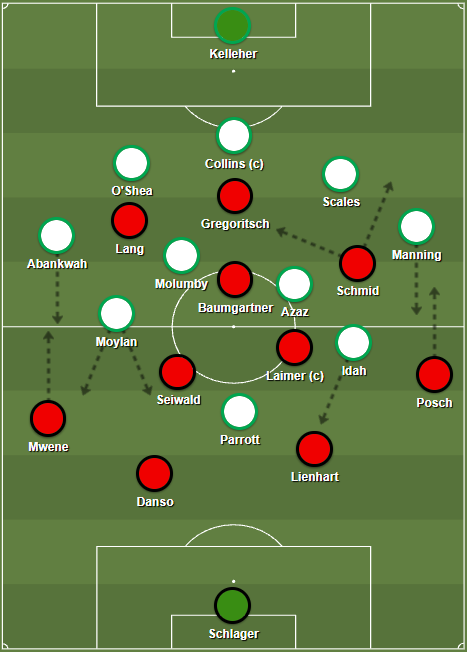
Rangnick’s initial tactical approach was clear from the get-go. He asked wide players Romano Schmid and Christoph Lang to join Christoph Baumgartner in seeking space between the lines, overloading Ireland’s central midfield pair. Austria also looked to funnel Ireland’s build-up towards the technically limited Liam Scales, with the speedy Schmid primed to press him as soon as the ball came his way.
Neither tactic bore much fruit, however, as Hallgrímsson had clearly anticipated what was coming and set his team up accordingly. Ireland defended in a narrow, extremely compact 5-4-1, generally in a mid-to-low block. The back five held a relatively high line, staying close to the midfield and denying Austria’s assortment of attacking midfielders time and space. It was telling, as the half wore on, that Schmid began to pull wider and Austria began resorting to hopeful balls over the top of Ireland’s well-drilled backline.
Ireland also coped well with Austria’s press, the hosts’ calling card, playing around it at times and using Troy Parrott as a typically effective out-ball at others. Even Scales, the main target of that pressure, came through the first half with a surprisingly high 89% pass completion rate. Schmid did, however, harry him into giving the ball away for Austria’s only significant chance of the half, with Caoimhín Kelleher saving from Lang. Ireland’s 45% share of first-half possession gives some indication of how well they held onto the ball in the face of the full-frontal assault Rangnick had orchestrated.
Ireland often gave as good as they got in that regard, too. At Austrian restarts, they pressed high at times to disrupt their hosts’ build-up, cutting off passes into the likes of Baumgartner at source. On the ball, however, Hallgrímsson’s side struggled to create, with Finn Azaz, again deployed in central midfield, particularly wasteful in possession. Jack Moylan, sensational in the Championship this season, struggled to make an impact on the right of the attack. It hardly helped Moylan’s cause, though, that James Abankwah again looked a fish out of water at right wing-back. Abankwah was given time on the ball deep in the Austrian half on several occasions before the break but did precious little with it.
With Seamus Coleman currently without a club, Hallgrímsson’s options at right wing-back are very limited. In general, it is difficult to criticise either his starting approach or his starting lineup — this, in other words, was a far cry from Kosovo away. Conor Coventry could count himself unlucky to miss out, but pairing Jayson Molumby’s engine with with Azaz’s passing credentials, on paper at least, made sense. So did keeping the attacking trio of Moylan, Parrott and Adam Idah together, with Parrott and Idah again showing signs of developing a promising understanding. What a shame, then, that Idah repeatedly failed to attack deliveries from the right to the back post, and that he also spurned a golden rebound opportunity after Parrott tested Austrian goalkeeper Alexander Schlager on the break.
Where Hallgrímsson is open to criticism is in his use of the bench, a perennial problem for the Ireland boss. Moments after the counterattack that almost put his side ahead, he made three head-scratching changes, the most damaging of which saw Jake O’Brien replace Ryan Manning. O’Brien went in on the right of the back three, meaning that Dara O’Shea, who had been playing very well there, switched to the left and Scales moved out to wing-back — despite having looked totally lost in that role in Kosovo. A similarly unnecessary change on the left of the back three, when Liam Kitching replaced Scales, had ushered Austria back into the game in the reverse fixture.
The contrast with his opposite number could hardly have been starker. Having watched Ireland thwart his team’s attempts to play through the lines for an hour, Rangnick brought on the 6ft 7in target man Sasa Kalajdzic and asked him to play as a ten, just off Michael Gregoritsch. The idea was to go direct to the LASK striker, and the impact was immediate. Within seconds of coming on, Kalajdzic got on the end of a long ball from Schlager, leading to Baumgartner forcing a strong save from the again imperious Kelleher. Two minutes later, Kalajdzic repeated the trick, popping up between the lines to flick another long pass on to Baumgartner, who skewed his shot wide. It was Austria’s best chance to that point. Nathan Collins had been following Gregoritsch out of the back line, and there seemed to be some confusion over who should pick up Kalajdzic.
Ultimately, of course, Kalajdzic scored the only goal of the game from one of Schmid’s many well-delivered corners. Much will be said and written about the error-prone Collins getting caught in possession by Kalajdzic in the build-up to the corner, but the sequence began with an uncomfortable Scales giving the ball away cheaply on the left touchline under minimal pressure from Konrad Laimer. Here, in a nutshell, was the impact of both managers’ changes. After the horse had bolted, Hallgrímsson made one final head-scratcher of a change, replacing Abankwah with Bosun Lawal at right wing-back. One defensively minded player better suited to a central role had made way for another.
Conclusion
So ended another frustrating night of what-ifs for Ireland under the current management team. Hallgrímsson has undoubtedly improved on the efforts of his predecessor, Stephen Kenny; Ireland are far better set up from the start and far more likely to compete with sides of a similar or higher standard. Gone are the days when opposition sides could frolic in the wide-open spaces between the Irish defence and midfield and score for fun from outside the area.
But one hallmark of Kenny’s abject reign persists. Hallgrímsson, too, struggles to change a game from the sideline and use his bench shrewdly, albeit to a lesser extent than Kenny did. Perhaps O’Brien for Manning can be partly excused by the fact that Manning was a yellow card away from suspension for Tuesday’s decider against Kosovo. That was certainly the explanation Hallgrímsson offered in his post-match chat with RTÉ’s Tony O’Donoghue. Perhaps he also felt his side needed more height, given the joy Austria were getting from corners.
But neither explanation justifies breaking up a central defensive unit that was working, and working well. Most frustratingly, Hallgrímsson keeps making this mistake. There was Kitching’s fateful introduction against Austria in Dublin, and you can go as far back as October 2025, when Portugal beat Ireland with a late back-post header. Four minutes from time, Hallgrímsson had inexplicably taken off Coleman, who had been defending that area well and later said he “could have continued”.
Moving Azaz deeper into central midfield away to Hungary might be the only decisive change Hallgrímsson has made from the sideline in his time as Ireland boss. Too often, his changes are illogical, ill-timed and ineffectual. If Ireland are to reach the heights they seem tantalisingly close to touching, that needs to change.
Follow the author, Alan O’Brien, on X: Follow @alanob2112

