This game, as is often the case in international football, was a tale of two managers: one, Armenia’s Eghishe Melikyan, who learned the lessons of Matchday One; and another, Ireland’s Heimir Halgrimsson, who did not.
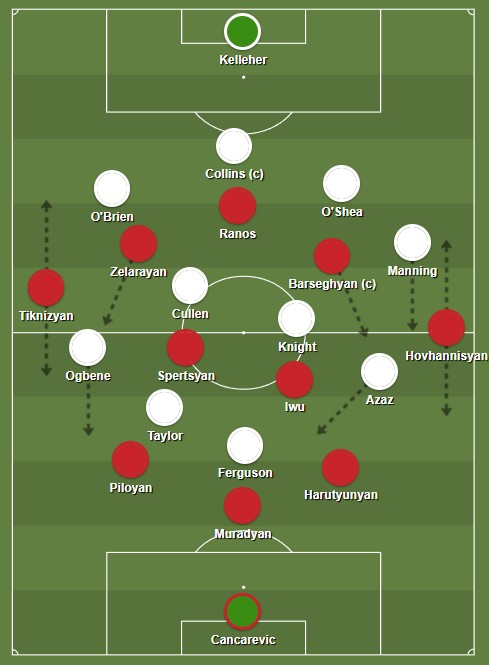
Melikyan selected a 5-3-2 for his first game in charge against Portugal, and in doing so surrendered the flanks and watched as Joao Cancelo led his side to a facile 5-0 victory. Four of the goals in that rout emanated from crosses; Melikyan was not about to afford Ireland the same opportunity.
Ireland, of course, attempted a staggering 36 crosses throughout their second-half fightback against Hungary, who narrowed into a 5-3-1 after Rolland Sallai’s dismissal. In Yerevan three nights later, however, they sent in a paltry total of only 13 across ninety minutes. And this fall off is directly attributable to the tactical approach of Melikyan, who dumped 5-3-2 in favour of 5-4-1, ensuring that each wide player in Ireland’s 3-4-2-1 attacking shape had two players to worry about at all times. Ireland, instead, were invited to attack their hosts through the centre, but predictably lacked the guile to do so effectively.
Melikyan’s 5-4-1 was merely a defensive shape, however. In attack, the Armenians assumed an ultra-attacking 3-2-5 shape, with both wing-backs pushed way up the pitch. This interpretation of 5-4-1 often spells disaster for teams defending with a back-four (as Ireland again were) as the attacking wing-backs drag the defensive full-backs out to the touchlines, creating massive gaps between the defending side’s full-backs and centre-backs. This was particularly evident for Armenia’s second goal, when Irish right-back Jake O’Brien had not one but two players outside him and, therefore, could not narrow his position. Nathan Collins, who again endured a sleepy, error-strewn outing, failed to narrow the gap himself. And Eduard Spertsyan duly threaded a ball through that gap to wing-back Tiknizyan who squared to striker Grant-Leon Ramos.
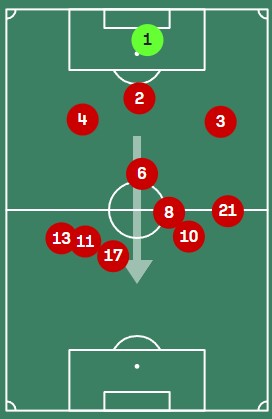
The freedom Spertsyan had exploited to thread that through ball highlighted the other major dimension to Hallgrimsson’s tactical failure on the night. Hallgrimsson claimed before the match that he was bringing Jack Taylor into the team to provide an extra body in midfield, a two-man midfield that had been continually overrun against Hungary. But once the game began it became clear that Ireland were once again defending in a 4-4-2, with Taylor fielded as a second striker just off Evan Ferguson. Now, if fielding a back four against an attacking five often spells disaster, doing so with a 4-4-2 simply guarantees it. Armenia used their dual-number 10s to create 4-v-2 overloads in central midfield, thereby dominating possession against a team ranked 45 places above them.
And, once Hallgrimsson went gung-ho at half-time by introducing Adam Idah and switching to a 4-4-2 in all phases of the game, Armenia enjoyed even more space. The unfancied hosts were afforded the room to thread three through balls in the second half, which may not sound like a lot, but at elite level it most certainly is. It’s telling that Ireland’s only two significant chances of the game (Ferguson’s goal and the chance he set up for Taylor in the first half) came on the counter-attack; that’s how dominant Armenia were and how attack-minded they continued to be throughout the game. They smelled blood from the off and they extracted it in spades.
Again, the second goal is revealing in this regard. In the 51st minute, while leading 1-0 at home to a more fancied side who were going gung-ho, Armenia had four players up against Ireland’s defensive line, with an additional one, the captain Tigran Barseghyan, stationed just off them in the inside-right half-space. That demonstrates incredible tactical bravery from Melikyan and he should have been rewarded more handsomely for it. Caoimhin Kelleher denied Tiknizyan and spared Ireland further blushes after another unpressed Spertsyan through-ball found its target.
Conclusion
The bottom line here is that one manager maximised the output of his relatively limited group of players by getting his tactical approach right. And the other ended up with a team far less than the sum of its parts. Ireland, despite the cries of those who insist they do not have the players, are possessing of more than enough Premier League and Championship talent to comfortably win games of this nature. And although it’s true that some players, like Collins, have a habit of saving their horror shows for the days they are wearing green, the buck stops with the manager. Hallgrimsson, like Stephen Kenny before him, is not getting the best out of what he has and the hybrid 4-4-2/3-4-2-1 was unequivocally the wrong choice for these games against Hungary and Armenia.
Having seen what Hungary’s wing-backs (especially Bendeguz Bolla) did to his defence on Saturday night, Hallgrimsson should have reacted more quickly and appropriately when it became apparent that Armenia were employing an even more aggressive version of the same strategy. The Icelandic coach should have either switched to a defensive five as Ireland did (for a while) after half-time on Saturday. Or he should have reorganised his side into a 4-1-4-1/4-3-3, with high wingers pinning back the Armenia wing-backs and an extra body in central midfield. Instead, he did neither of those things and Ireland paid the price, falling to yet another embarrassing defeat against an ostensibly far weaker opponent. Once again, thanks to a failure of management, Irish World Cup dreams are over before they even had a chance to really begin.
Follow the author, Alan O’Brien, on X: Follow @alanob2112
 Tactics Truck v2.0