Heimir Hallgrímsson appears to represent a significant improvement on his subpar predecessor as Ireland manager. But, after locking horns with Hungary boss Marco Rossi, the former dentist must consider himself very fortunate to extract a late point from the jaws of a tactical defeat.
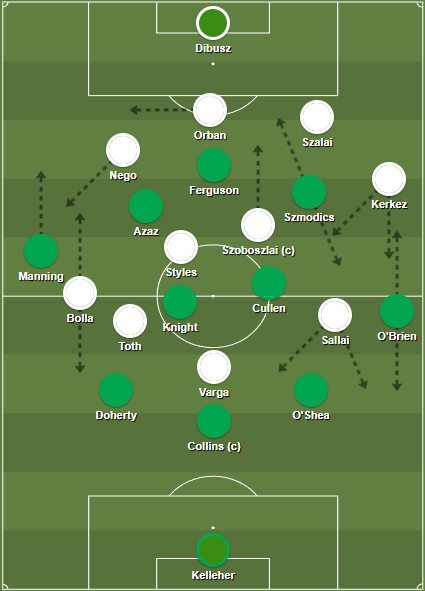
Grilled in the game’s aftermath about how his side found themselves 2-0 down after 15 minutes, Hallgrímsson bemoaned the failure of his players to win their individual battles, declaring them “sloppy in the duels”. To an extent, this is a fair assessment; individual lapses from Nathan Collins and, in particular, Matt Doherty gave rise to that dismal state of affairs. Here, however, the Icelandic coach was also letting himself off the hook for losing his own duel with Rossi, attributing blame to himself only for perhaps not preparing his side psychologically to the requisite degree.
Once again, Hallgrímsson opted for a hybrid system: 4-4-2-ish in defence and 3-4-2-1 in attack. And as the game developed early on, it became clear that Hungary were evincing a great deal of fluidity, too. Broadly 5-4-1 in defence and 3-4-2-1 in attack, Rossi’s system looked more like a 4-3-3 in the buildup phase, with Dominik Szoboszlai dropping back between two of Hungary’s three centre-backs to dictate play from deep. Right-sided centre back Loic Nego pushed wide into an orthodox right-back role, with right wing-back Bendeguz Bolla pushed way up onto Doherty, Ireland’s left-back when out of possession. Doherty’s continual inability to deal with the surprising positioning of Bolla led directly to Hungary’s second, Bolla capitalising on the shared indecision of Doherty and Collins to convert an aimless long ball into a decisive corner.
That such a simple set-piece routine undid Ireland should worry those who have banked on Hallgrímsson changing Irish fortunes. Nego’s dummy run to the near-post achieved its desired effect, distracting Ireland’s zonal markers enough to allow second-half villain Roland Sallai a free header. Hallgrímsson had staked his reputation on both open-play organisation and effectiveness from set plays; that Hungary scored from their only dead-ball shot on goal, therefore, is a real black mark in the coach’s copybook.
Ireland’s efforts in open play left a lot to be desired as well, as Rossi’s customary man-to-man pressing, deployed in the middle and defensive thirds, prevented Ireland from working the ball through midfield. In this regard, Rossi’s chosen defensive shape, 5-4-1, matched up perfectly with Hallgrímsson’s offensive shape, 3-4-2-1. After their second goal, however, Hungary changed emphasis and their early possession dominance (63% from minutes 0-15) gave way to time-wasting and passivity (26% from minutes 16-45).
Ireland were seeing more of the ball, in other words, but demonstrated precious little ability to penetrate Rossi’s low block and man-oriented press. Indeed, it was incredibly uncommon to see an Irishman get the better of his “marker” in the first half. I counted only three significant examples: Jake O’Brien reaching the byline to find Finn Azaz with a cross in the 10th minute; Azaz turning Szoboszlai, the only successful dribble of the first half; and Evan Ferguson beating his man to chest down a long ball and force a save before half-time. Indeed, the home side only pulled a goal back early in the second-half thanks to a counter-attack from which Ferguson won a free-kick and ultimately converted its scraps.
Despite the aforementioned defensive shift from the visitors, Ireland appeared to emerge from half-time with a slightly more cautious approach of their own, with Ryan Manning positioning himself deeper in what began to resemble a 5-4-1 out of possession. Perhaps this was Hallgrímsson’s decision, given how much Doherty struggled with Bolla in the first half; perhaps the players made the decision themselves. What gives weight to the latter theory, however, is the apparent sight of Hallgrímsson animatedly urging his players to revert to a defensive four less than ten minutes after Sallai’s 52th-minute red card.
This was a bizarre intervention from the Ireland boss given that Bolla had already enjoyed two shooting opportunities in the aftermath of his side going down to ten. Rossi, reacting adroitly, had moved to a 5-3-1 after the Sallai dismissal, introducing defensive midfielder Bence Otvos to anchor the centre of midfield behind Szoboszlai and the influential Callum Styles. This resulted, counter-intuitively, in a newfound numerical superiority in Hungary’s favour, with Ireland’s Josh Cullen and Jason Knight outnumbered three-to-two. Both Styles and Szobozslai began to repeatedly pop up free between the lines to feed Bolla. And, just seconds after Hallgrímsson bellowed at Manning to push up, Styles was again released behind Knight to find Bolla, whose run Doherty opted not to go with. Only a fine save from Caoimhin Kelleher denied Bolla and Hungary a decisive — and deserved — goal.
The siege that followed, Ireland pumping 36 second-half crosses into the mixer from mostly disadvantageous positions, does not bode well for the future either. Save for a couple of whipped efforts from the surprisingly effective Jake O’Brien, Manning was the real shining light in this period of play, completing an impressive nine of his 16 attempted crosses by game’s end, including the cross that led to Adam Idah’s late equaliser. Here was a rare example of Ireland eschewing harmless lofted balls from central areas in favour of patient build-up play and a well-timed cross from a good position.
With the Hungarian 5-3-1 packing the centre of the pitch, Ireland simply did not play with enough width after Sallai received his marching orders. Disappointingly, it took Hallgrímsson until the 78th minute to institute a 4-2-4, with a winger and a full-back attacking down both flanks. Indeed, it was substitute wideman Mikey Johnston who combined intelligently — and decisively — with Manning in the lead-up to the equaliser. Perhaps if that tactical tweak had arrived earlier, Ireland could have ran out winners. Although it’s difficult to be too critical of the Ireland manager. Belated though the change was, at least it was made; undoubtedly his predecessor would have sat on his hands.
Worryingly, Hallgrímsson seemed to make a virtue of the staggering number of crosses Ireland attempted (45, to Hungary’s 6) when speaking to media after the game, suggesting a lack of understanding regarding how poorly his side went about chasing the game. Victory against a poor Armenia side on Tuesday is by no means assured and if the Icelandic coach is to secure what looks like a necessary triumph in Budapest in November, he will need to turn the tactical tables on Rossi, who comprehensively outthought his opposite number in Dublin and unquestionably deserved all three points.
Follow the author, Alan O’Brien, on X: Follow @alanob2112
 Tactics Truck v2.0